
 En
En Cs
Cs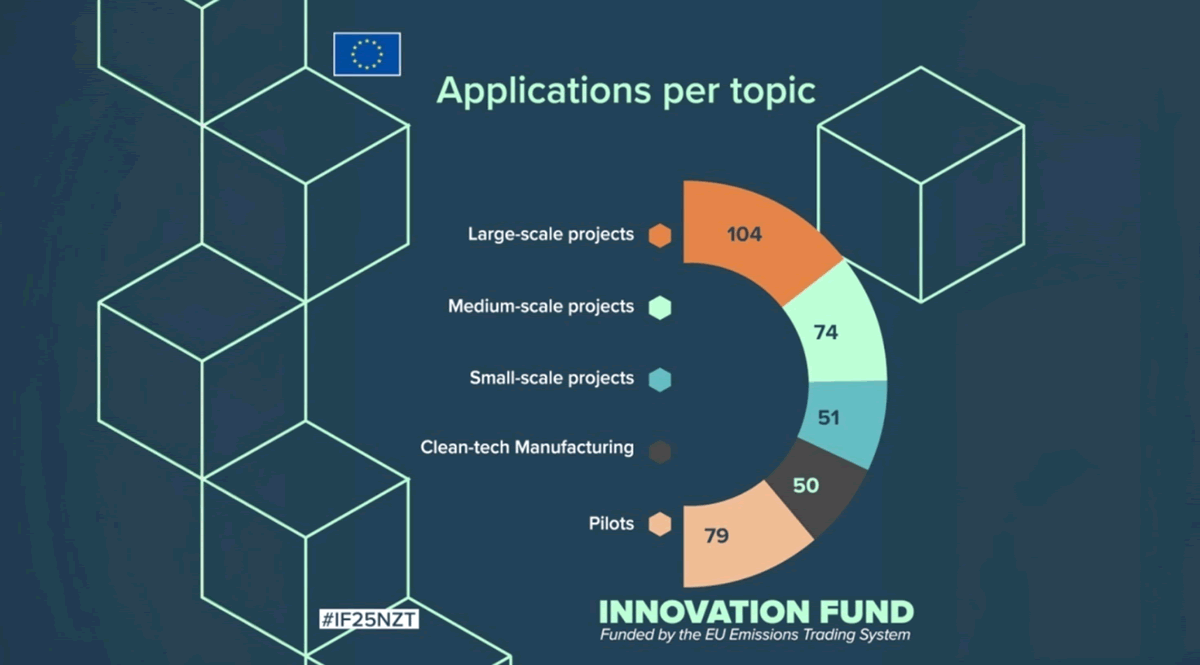
The European Commission’s 2025 Innovation Fund Net-Zero Technologies call (“Call”) attracted exceptionally high interest from industry, receiving 358 project applications from 27 EEA countries before its closure in April 2026. This strong participation demonstrates the growing momentum behind industrial decarbonisation and clean technology innovation across Europe, as well as the maturity of the project pipeline seeking EU support.
Applicants requested a total of EUR 17.5 billion in funding, which is six times higher than the available EUR 2.9 billion budget, highlighting a significant investment gap in scaling net-zero technologies. If implemented, these projects have the potential to avoid approximately 1.1 billion tonnes of CO₂ emissions over their first decade, underlining their major expected climate impact.
This oversubscription continues a trend seen in previous Innovation Fund calls and reflects strong and growing demand for EU financial support to commercialise innovative clean technologies. The initiative, funded through revenues from the EU Emissions Trading System (ETS), plays a central role in helping European industry become both more competitive and climate-neutral. An important feature highlighted in this round is the STEP Seal (Strategic Technologies for Europe Platform Seal). This label is awarded to high-quality projects that meet Innovation Fund evaluation thresholds, regardless of whether or not they are selected. Use this link to access a list of current STEP Seal projects.
The Call is closely aligned with key EU policy frameworks, including the Clean Industrial Deal, Net-Zero Industry Act, REPowerEU Plan, and the Critical Raw Materials Act. It aims to bridge financing gaps, mobilise private and public investment, and strengthen Europe’s leadership in clean technology manufacturing and deployment. Notably, EUR 1 billion is dedicated specifically to cleantech manufacturing and critical raw materials value chains within the EU.
Finally, the Call’s results show a broadening geographical participation, with project proposals coming from all 27 EEA countries and increasing engagement from previously underrepresented regions such as Malta, Luxembourg, Lithuania, Estonia, and Cyprus. This trend signals a more inclusive and widely distributed industrial transition, supporting the EU’s long-term goal of achieving climate neutrality while fostering economic resilience and innovation across Member States.