
 En
En Cs
Cs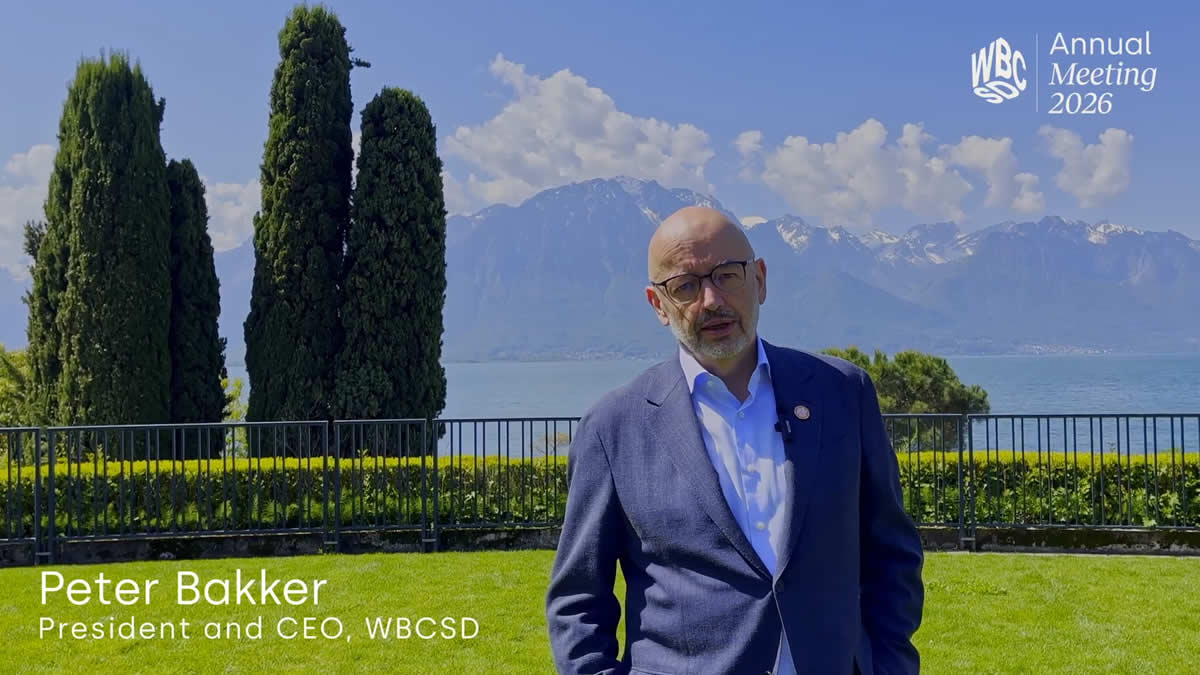
During last week of April 2026, the General Meeting of the World Business Council for Sustainable Development (“WBCSD“) took place in Montreux, Switzerland (“General Meeting“). The General Meetigs was attended by twof representatives of ČEZ, a.s., namely Zuzana Šillerová and Dušan Vácha. A video summarizing the key takeaways from the General Meeting is available at this link and an illustrative video on the WBCSD 30-year journey “Turning sustainability into your strongest business advantage – drive growth, resilience and long-term value“ at at this link.
Below is an overview of the main topics discussed during the General Meeting:
- Sustainability as a Source of Long-Term Corporate Value – Discussions focused on how to link the sustainability agenda with value creation, strategic management, capital allocation, and investor expectations, rather than perceiving it merely as a cost or reporting obligation.
- Decarbonization by 2030 and “No-Regret” Pathways Beyond 2030 – A key topic was the realistic achievability of climate targets, the role of value chains, the identification of no-regret measures, and the transition from commitments to implementation.
- Value Chain Collaboration as a Prerequisite for Impact – Recurrent discussions addressed how to engage suppliers, customers, and partners in decarbonization, circularity, data management, and risk governance, including cooperation with China, India, and other key regions.
- Data, Standards, and Reporting: From Compliance to Decision-Making – Discussions focused on carbon data (PCF), ESG ratings, the alignment of standards (ISO, GHG Protocol, SBTi, ISSB/ESRS), and how to ensure that reporting genuinely supports management decision-making.
- Nature, Biodiversity, and Nature-Based Solutions in Business – A major theme was the integration of nature into corporate strategies, ranging from the management of physical risks and Nature-Based Solutions to translating impacts and dependencies on nature into financial metrics.
- Electrification, Energy Transition, and Systemic Barriers – The program addressed practical barriers to electrification (grids, flexibility, investments, regulation) and the need for coordination among industry, cities, the energy sector, and regulators.
- Financing the Transition, Market Instruments, and Carbon Mechanisms – Topics included carbon credits, insetting, carbon dioxide removal (CDR), insurance against physical risks, and the role of finance in accelerating low-emission solutions.
- Leadership, Capabilities, and Behavioral Change – Attention was devoted to the role of leaders, organizational capabilities, “mind traps,” managing complexity, and how to translate sustainability strategy into day-to-day decision-making and organizational culture.
- Navigating Uncertainty: Geopolitics, Fragmentation, and Systemic Risks – Companies were discussing how to manage sustainability and investment decision-making in the context of geopolitical tensions, regulatory fragmentation, and increasing physical, social, and financial risks.
Circular Economy and Critical Materials – Discussions highlighted the role of circularity in reducing geopolitical and raw material risks.
The sessions during the General Meeting were not primarily aimed at presenting proven or “correct” solutions. Rather, they served as moderated discussions and a platform for monitoring the views of individual participants in order to align common positions, gather inspiration for further development, and shape the future direction of WBCSD.