
 En
En Cs
Cs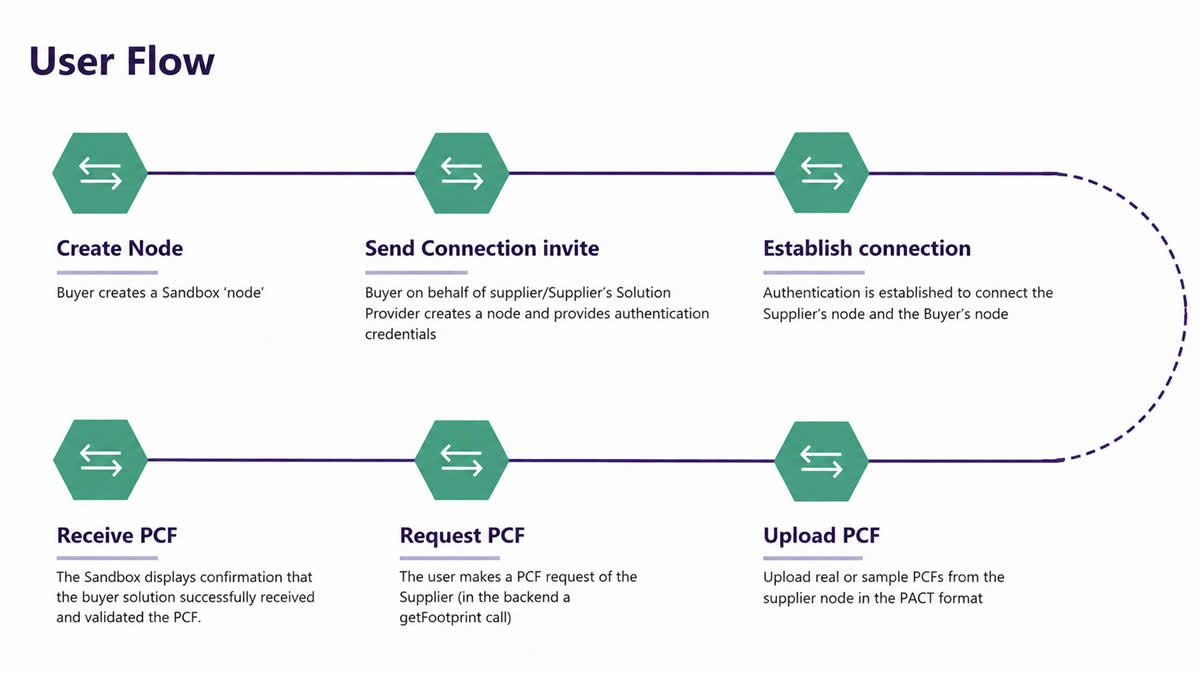
On 30 June 2026, the Partnership for Carbon Transparency (“PACT“) initiative of the World Business Council for Sustainable Development („WBCSD“) launched the Data Exchange Sandbox („Sandbox“), to address a major challenge in product carbon footprint (“PCFs“) management: the exchange of carbon data between companies with different SW. While standards and technologies for calculating PCFs already exist, many organizations still rely on spreadsheets, emails, and manual processes to share data across value chains, creating a significant barrier to efficient carbon transparency. The Sandbox and PACT Methodology are available at the following links: link1 and link2.
The Sandbox provides a secure, neutral, and free testing environment where companies and software providers can pilot PACT-conformant PCF data exchange before committing to full integrations. The platform supports PCF upload and exchange, node management, and user administration, while acting as a neutral exchange layer rather than a calculation tool or competing software solution.
PACT developed the Sandbox to help overcome integration challenges between buyers and suppliers, reduce barriers to testing interoperability, and accelerate the adoption of standardized carbon data sharing. By enabling organizations to validate data exchange in a low-risk environment, the initiative aims to support more seamless carbon transparency across supply chains.
PACT is a global initiative hosted by the WBCSD that provides a standardized framework for calculating and exchanging PCFs across value chains. Launched in 2020, its primary goal is to solve the transparency challenge of Scope 3 emissions (indirect supply chain emissions) by replacing industry averages with accurate, primary, and verified data