
 En
En Cs
Cs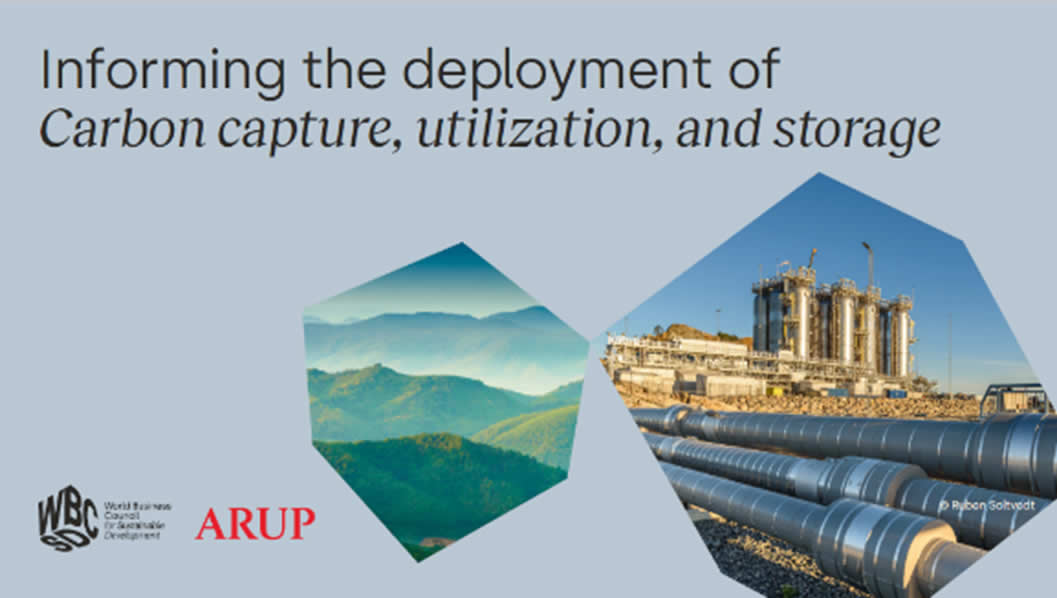
On 26 February 2026, the World Business Council for Sustainable Development (WBCSD), in collaboration with ARUP, released a report “Informing the Deployment of Carbon Capture, Utilization, and Storage”, which addresses the concept and technologies of carbon capture, utilization, and storage (“CCUS”) as a viable and practical way to prevent greenhouse gases from entering the atmosphere (“Report”). Its main aim is to cut through common misconceptions and provide decision-makers with a practical overview of the technology, infrastructure, economics and policy conditions needed for credible deployment. The Proposal is available at this link.
It shows that CCUS is no longer only a theoretical solution. The Report states that around 51 MtCO2 per year of capture capacity is already operating globally, with another 21 MtCO2 under construction and much larger volumes planned by 2030. It also emphasizes that modern capture systems commonly achieve capture rates above 90%, while transport and geological storage are supported by existing industrial practice, monitoring and regulation.
The key conclusions of the Report are as follows:
- CCUS is presented as a practical and already deployable solution, especially for hard-to-abate sectors such as cement, steel, chemicals and refining. The REport emphasizes that CCUS is no longer just a theoretical option, but a technology with growing project pipelines and operational experience.
- The main barriers are not primarily technical, but commercial, infrastructural and regulatory. Successful deployment of CCUS requires coordination across the full chain from capture to transport to permanent storage, supported by stable policy frameworks and viable business models.
- Frequent common misconceptions exist about CCUS. Modern systems can achieve high capture rates, the energy penalty does not erase the climate benefit, CO2 transport can be managed safely, and geological storage can be secure and durable under proper regulation and monitoring.
- Permanent geological storage is identified as essential for durable climate impact. CO2 utilization may create value, but in many cases it only delays emissions rather than preventing them permanently.
- CCUS should complement, not replace, other decarbonization pathways. The study recommends an “abatement first” approach, meaning CCUS should be used where it delivers a clear and credible benefit and where better alternatives such as electrification, efficiency or renewables are limited.
In conclusion, the Report calls for shared CO2 networks, interoperable standards, transparent reporting and stronger market frameworks so that CCUS can move from isolated projects toward scalable, commercially sustainable deployment.