
 En
En Cs
Cs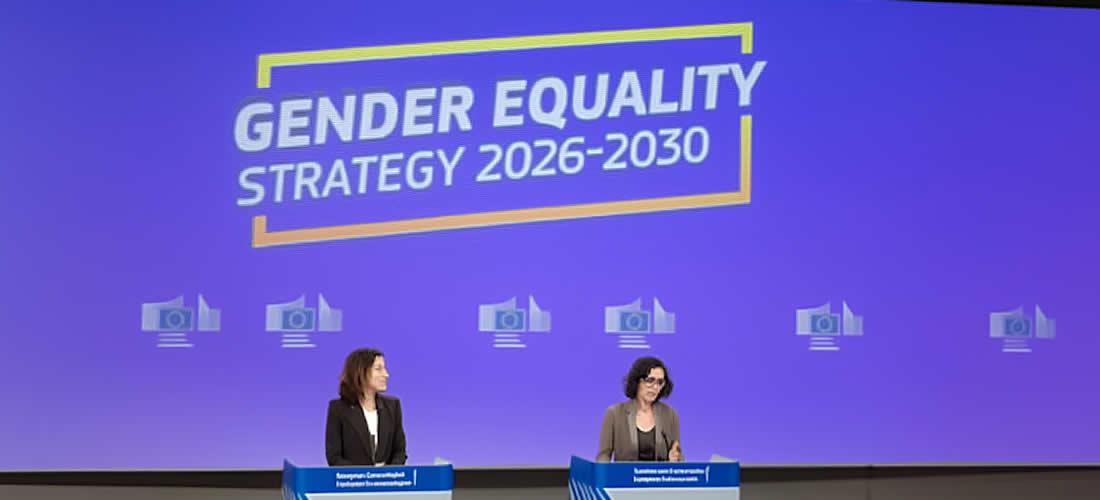
Ahead of this year’s International Women’s Day on 8 March, the European Commission presented its Gender Equality Strategy 2026-2030 on 5 March 2026 (“Strategy“). The Strategy embeds gender equality into every aspect of life, online and offline. It turns the objectives of the Commission’s Roadmap for Women’s Rights that was endorsed in 2025 by all EU countries, into concrete actions to empower women and girls, engage men and boys, vigorously oppose any backtracking on fundamental rights, and accelerate progress towards a truly gender-equal Europe. The Strategy is available at this link.
The main areas of action pursuant to the Strategy are as follows:
- Continuing the fight against gender-based violence with an emphasis on fighting cyberviolence, which disproportionately impacts women and girls, with measures to combat sexually explicit deepfakes and deepnudes and improve the protection of women online.
- Engaging men and boys in the fight for gender equality, recognising their important role in bringing about societal change, focusing on how to counter information manipulation and disinformation to avoid growing polarisation between women and men, particularly among young people.
- Promoting the highest standards of health and healthcare systems built for allby including an initiative together with the World Health Organization to improve the quality and accessibility of women’s healthcare.
- Boosting prosperity by promoting gender equality across economic sectorswith actions to attract more women into research, innovation, startups, and to science, technology, engineering and mathematics (STEM) careers and encourage men to study and work in health, education, administration and literacy.
- Tackling the gender pay and pension gaps, including by supporting EU countries to fully implement the Pay Transparency Directive, and work with the European Investment Bank to improve access to finance for women entrepreneurs and boost female representation in the financial sector.
- Taking further steps to support women’s equal and safe participation in politicsincluding by tackling information manipulation and interference online which often drives polarisation between women and men.
Continuing to promote gender equality on the global stage with a new gender action plan for 2028-2034, and a new action plan for women, peace and security. The EU will also launch a new flagship initiative ‘SHIELD’ which will focus on improving access to sexual and reproductive health and supporting survivors of gender-based violence.
In this context, it is worth noting that the average unadjusted gender pay gap in the EU was 11.1% in 2024. In 2024, in the EU, Estonia and Czechia recorded the highest (18.8% and 18.5%) and Luxembourgh the lowest (-0.8%) gender pay gaps respectively, before accounting for factors that affect final pay. The gender pay gap in Czechia varies significantly by age, according to the Eurostat data. Among Czech workers under 25, the difference is relatively low at 7.7 percent. It grows substantially during mid-career years, peaking at 21.6 percent among employees aged 35 to 44 — the period when many people balance career advancement with family responsibilities. The gap narrows again among older workers, falling to 8.2 percent for those aged 65 and above. Sector differences are even more pronounced. The largest pay gaps are in finance and insurance, where women earn 35.6 percent less than men. The information and communications sector follows with a 28.4 percent gap, while health and social care shows a 24.9 percent difference. For more information on gender-related pay gaps, see this link.